
Share with a co-worker


The Challenge
Well performance started to decline across several assets, at times pushing operations toward unplanned downtime. Engineers suspected a familiar but hard-to-prove culprit: undissolved salt accumulating inside the wells.
The only visible clue appeared in the data. When the choke valve position remained constant yet flow and pressure showed a repeating sawtooth pattern, it indicated a solubility shift triggering salt fallout. The issue wasn’t just identifying these events, it was detecting them early enough to act before production losses escalated.
- Hidden performance loss due to salt precipitation
- Risk of well downtime if buildup continued
- No systematic way to detect sawtooth patterns in real time
- Limited visibility into when intervention was truly needed
The Approach
To move from reactive troubleshooting to proactive control, the team built a monitoring framework that could automatically detect abnormal well behavior and guide operators toward timely action.
- Noise-Resilient Signal Conditioning: Choke valve position was averaged to remove noise and ensure reliable pattern detection.
- Pattern Detection Logic: A weighted multivariate similarity search identified isolated abnormal behaviors based on signal shape rather than simple thresholds.
- Real-Time Monitoring: A dedicated monitor was configured to flag abnormal well behavior and recommend corrective choking actions.
- Historical Context Dashboards: Dashboards tracked event frequency and trends, enabling engineers to visualize when and how often sawtooth patterns occurred.
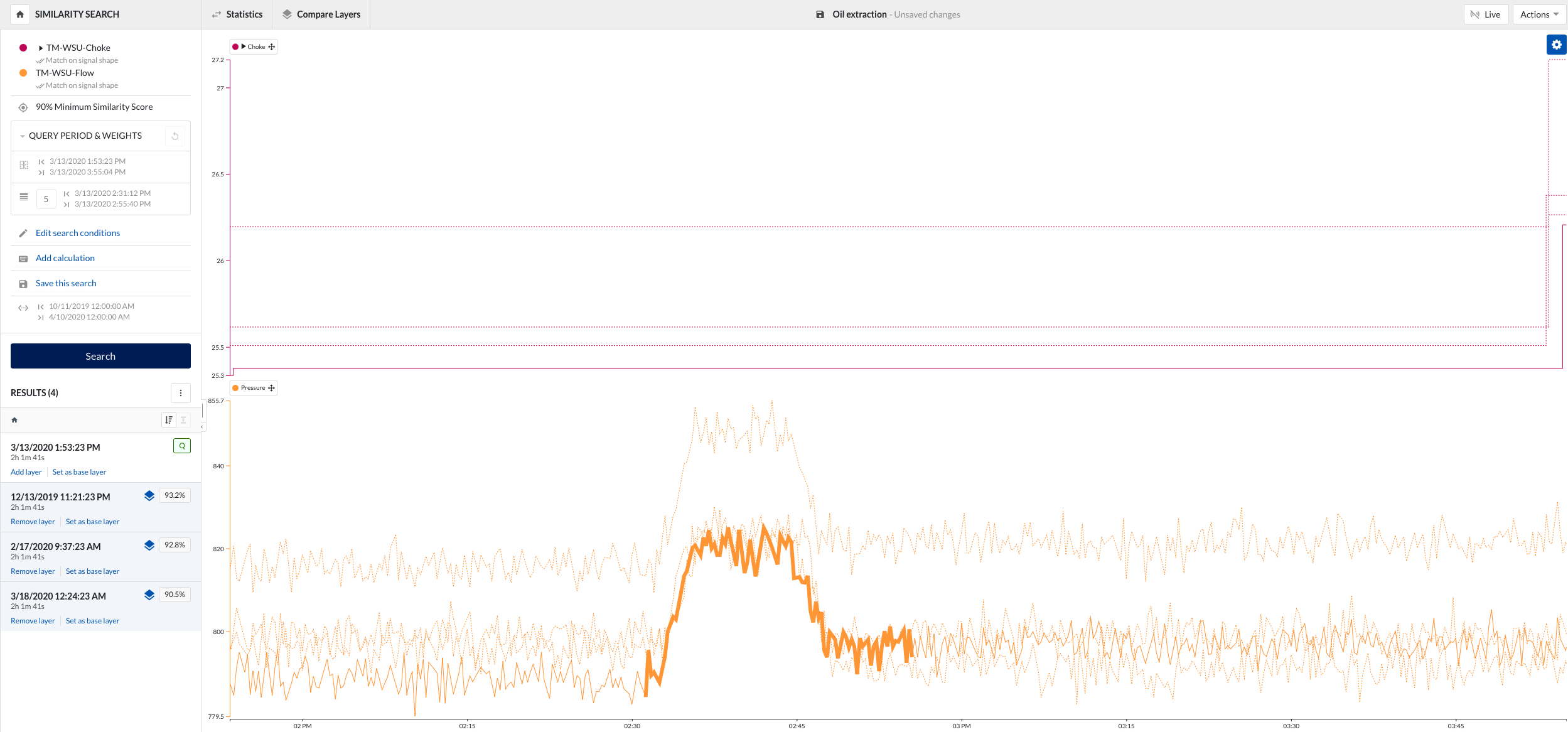
Key Insight
Once sawtooth signatures were automatically detected and contextualized, operators could intervene earlier, before salt buildup translated into measurable production loss.
The Results
The Takeaway
By transforming subtle signal patterns into actionable insights, the team turned a hidden production risk into a controllable operating condition—reducing performance losses caused by salt issues and unlocking up to $150,000 per month in recovered value.
The Challenge
Well performance started to decline across several assets, at times pushing operations toward unplanned downtime. Engineers suspected a familiar but hard-to-prove culprit: undissolved salt accumulating inside the wells.
The only visible clue appeared in the data. When the choke valve position remained constant yet flow and pressure showed a repeating sawtooth pattern, it indicated a solubility shift triggering salt fallout. The issue wasn’t just identifying these events, it was detecting them early enough to act before production losses escalated.
- Hidden performance loss due to salt precipitation
- Risk of well downtime if buildup continued
- No systematic way to detect sawtooth patterns in real time
- Limited visibility into when intervention was truly needed
The Approach
To move from reactive troubleshooting to proactive control, the team built a monitoring framework that could automatically detect abnormal well behavior and guide operators toward timely action.
- Noise-Resilient Signal Conditioning: Choke valve position was averaged to remove noise and ensure reliable pattern detection.
- Pattern Detection Logic: A weighted multivariate similarity search identified isolated abnormal behaviors based on signal shape rather than simple thresholds.
- Real-Time Monitoring: A dedicated monitor was configured to flag abnormal well behavior and recommend corrective choking actions.
- Historical Context Dashboards: Dashboards tracked event frequency and trends, enabling engineers to visualize when and how often sawtooth patterns occurred.
Key Insight
Once sawtooth signatures were automatically detected and contextualized, operators could intervene earlier, before salt buildup translated into measurable production loss.
The Results
The Takeaway
By transforming subtle signal patterns into actionable insights, the team turned a hidden production risk into a controllable operating condition—reducing performance losses caused by salt issues and unlocking up to $150,000 per month in recovered value.
Access now
Share with a co-worker
The Challenge
Well performance started to decline across several assets, at times pushing operations toward unplanned downtime. Engineers suspected a familiar but hard-to-prove culprit: undissolved salt accumulating inside the wells.
The only visible clue appeared in the data. When the choke valve position remained constant yet flow and pressure showed a repeating sawtooth pattern, it indicated a solubility shift triggering salt fallout. The issue wasn’t just identifying these events, it was detecting them early enough to act before production losses escalated.
- Hidden performance loss due to salt precipitation
- Risk of well downtime if buildup continued
- No systematic way to detect sawtooth patterns in real time
- Limited visibility into when intervention was truly needed
The Approach
To move from reactive troubleshooting to proactive control, the team built a monitoring framework that could automatically detect abnormal well behavior and guide operators toward timely action.
- Noise-Resilient Signal Conditioning: Choke valve position was averaged to remove noise and ensure reliable pattern detection.
- Pattern Detection Logic: A weighted multivariate similarity search identified isolated abnormal behaviors based on signal shape rather than simple thresholds.
- Real-Time Monitoring: A dedicated monitor was configured to flag abnormal well behavior and recommend corrective choking actions.
- Historical Context Dashboards: Dashboards tracked event frequency and trends, enabling engineers to visualize when and how often sawtooth patterns occurred.
Key Insight
Once sawtooth signatures were automatically detected and contextualized, operators could intervene earlier, before salt buildup translated into measurable production loss.
The Results
The Takeaway
By transforming subtle signal patterns into actionable insights, the team turned a hidden production risk into a controllable operating condition—reducing performance losses caused by salt issues and unlocking up to $150,000 per month in recovered value.
Access now
Subscribe to our newsletter
Stay up to date with our latest news and updates.
Webinars on Demand
Press Play on Operational Improvement
.jpeg)
.jpeg)
.jpeg)
Other Resources
Explore Our Newest Content to Maximize Your Operational Efficiency