Share with a co-worker
All Resources
Use case

The Challenge
Electricity demand in Vestmannaeyjar is highly weather-dependent, as power is primarily used for heating. However, operational planning lacked a structured way to link weather forecasts to future MW demand.
The key challenges were:
- Integrating reliable external weather data into TrendMiner
- Correlating wind, temperature, humidity, and sunshine with electricity consumption
- Building a predictive model to estimate required MW production
- Transitioning from reactive analysis to forward-looking forecasting
Without predictive capability, production planning relied on historical patterns rather than forecast-driven optimization.
The Approach
A predictive workflow was built combining external weather data and TrendMiner’s calculation capabilities:
- Weather data (including “feels like” temperature and wind) was integrated via API (open-meteo) using custom calculations
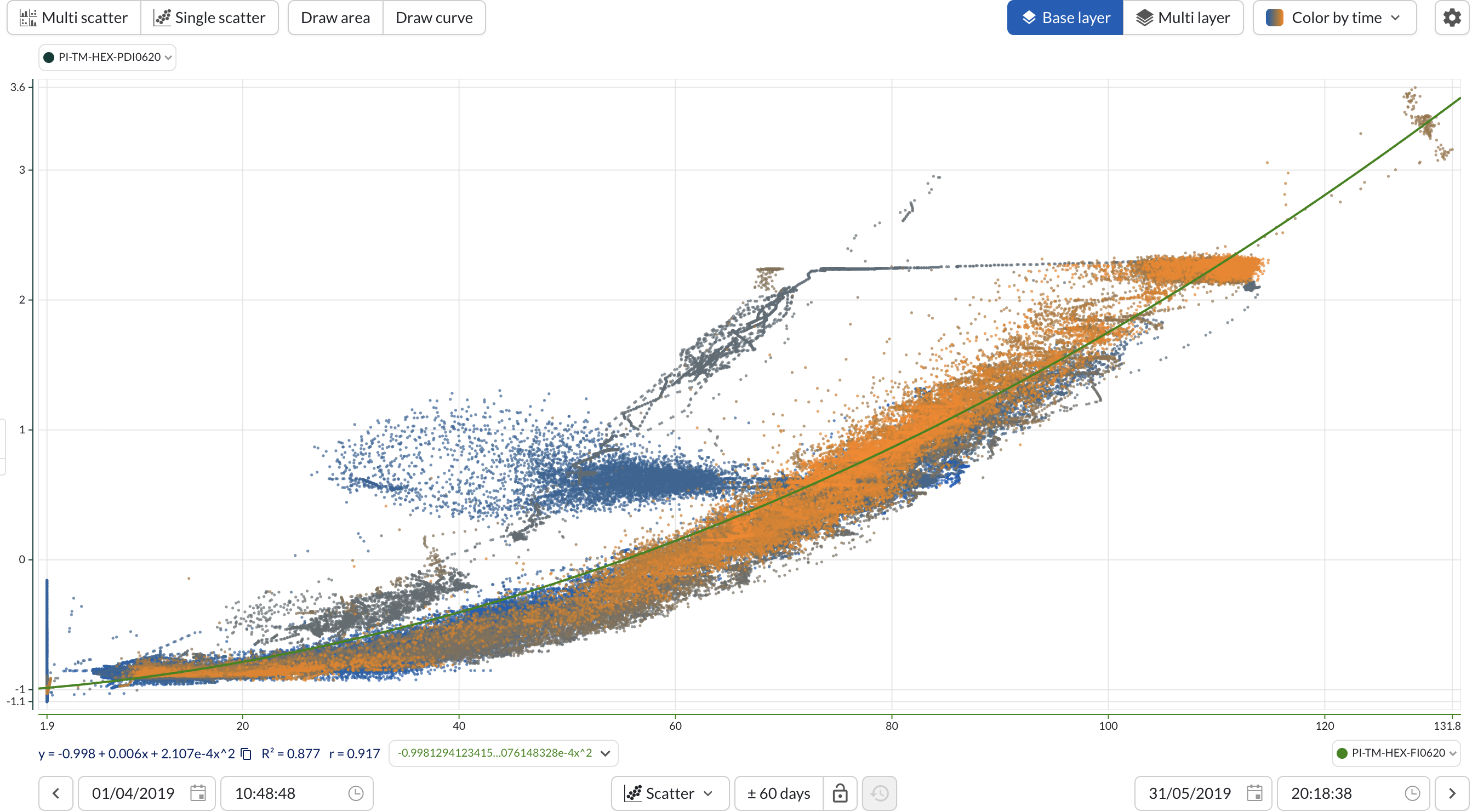
- Correlation analysis was performed between weather parameters and electricity consumption
- A regression model was created using the Prediction Tag to estimate total energy demand
- The resulting equation was implemented in a formula tag
- Instead of using current weather values, forecasted weather data for the next 24 hours was applied to predict upcoming energy needs
This transformed TrendMiner from a monitoring tool into a short-term demand forecasting engine.
The Results
The Takeaway
The organization now has a predictive tag that estimates upcoming energy demand based on weather forecasts, enabling more accurate production planning, improved load balancing, and reduced operational uncertainty in weather-sensitive power generation.
The Challenge
Electricity demand in Vestmannaeyjar is highly weather-dependent, as power is primarily used for heating. However, operational planning lacked a structured way to link weather forecasts to future MW demand.
The key challenges were:
- Integrating reliable external weather data into TrendMiner
- Correlating wind, temperature, humidity, and sunshine with electricity consumption
- Building a predictive model to estimate required MW production
- Transitioning from reactive analysis to forward-looking forecasting
Without predictive capability, production planning relied on historical patterns rather than forecast-driven optimization.
The Approach
A predictive workflow was built combining external weather data and TrendMiner’s calculation capabilities:
- Weather data (including “feels like” temperature and wind) was integrated via API (open-meteo) using custom calculations
- Correlation analysis was performed between weather parameters and electricity consumption
- A regression model was created using the Prediction Tag to estimate total energy demand
- The resulting equation was implemented in a formula tag
- Instead of using current weather values, forecasted weather data for the next 24 hours was applied to predict upcoming energy needs
This transformed TrendMiner from a monitoring tool into a short-term demand forecasting engine.
The Results
The Takeaway
The organization now has a predictive tag that estimates upcoming energy demand based on weather forecasts, enabling more accurate production planning, improved load balancing, and reduced operational uncertainty in weather-sensitive power generation.
Access now
Share with a co-worker
The Challenge
Electricity demand in Vestmannaeyjar is highly weather-dependent, as power is primarily used for heating. However, operational planning lacked a structured way to link weather forecasts to future MW demand.
The key challenges were:
- Integrating reliable external weather data into TrendMiner
- Correlating wind, temperature, humidity, and sunshine with electricity consumption
- Building a predictive model to estimate required MW production
- Transitioning from reactive analysis to forward-looking forecasting
Without predictive capability, production planning relied on historical patterns rather than forecast-driven optimization.
The Approach
A predictive workflow was built combining external weather data and TrendMiner’s calculation capabilities:
- Weather data (including “feels like” temperature and wind) was integrated via API (open-meteo) using custom calculations
- Correlation analysis was performed between weather parameters and electricity consumption
- A regression model was created using the Prediction Tag to estimate total energy demand
- The resulting equation was implemented in a formula tag
- Instead of using current weather values, forecasted weather data for the next 24 hours was applied to predict upcoming energy needs
This transformed TrendMiner from a monitoring tool into a short-term demand forecasting engine.
The Results
The Takeaway
The organization now has a predictive tag that estimates upcoming energy demand based on weather forecasts, enabling more accurate production planning, improved load balancing, and reduced operational uncertainty in weather-sensitive power generation.
Access now
Subscribe to our newsletter
Stay up to date with our latest news and updates.
Webinars on Demand
Press Play on Operational Improvement
.jpg)
.jpg)
.jpg)
Other Resources
Explore Our Newest Content to Maximize Your Operational Efficiency