Share with a co-worker
All Resources
Use case


The Challenge
In a district heating system, a combined heat and power unit operates alongside a gas boiler to meet fluctuating thermal demand. A heat storage tank acts as a buffer between generation and consumption. Traditionally, the system was controlled using fixed rules, but increasing variability in outside temperature and electricity prices made this approach inefficient.
Operators needed to understand how CHP operation influenced storage charging and discharging behavior under different external conditions, and more importantly, determine when the CHP should start to avoid unnecessary boiler activation.
- Limited visibility into storage charging and discharging dynamics
- Static control logic unable to adapt to changing conditions
- Risk of late CHP starts triggering gas boiler use
- Difficulty identifying optimal start timing rules
The Approach
Engineers conducted a structured time series analysis to uncover operational patterns and define smarter dispatch logic.
- Historical data exploration, relevant tags such as tank level, CHP output, demand, and outside temperature were analyzed
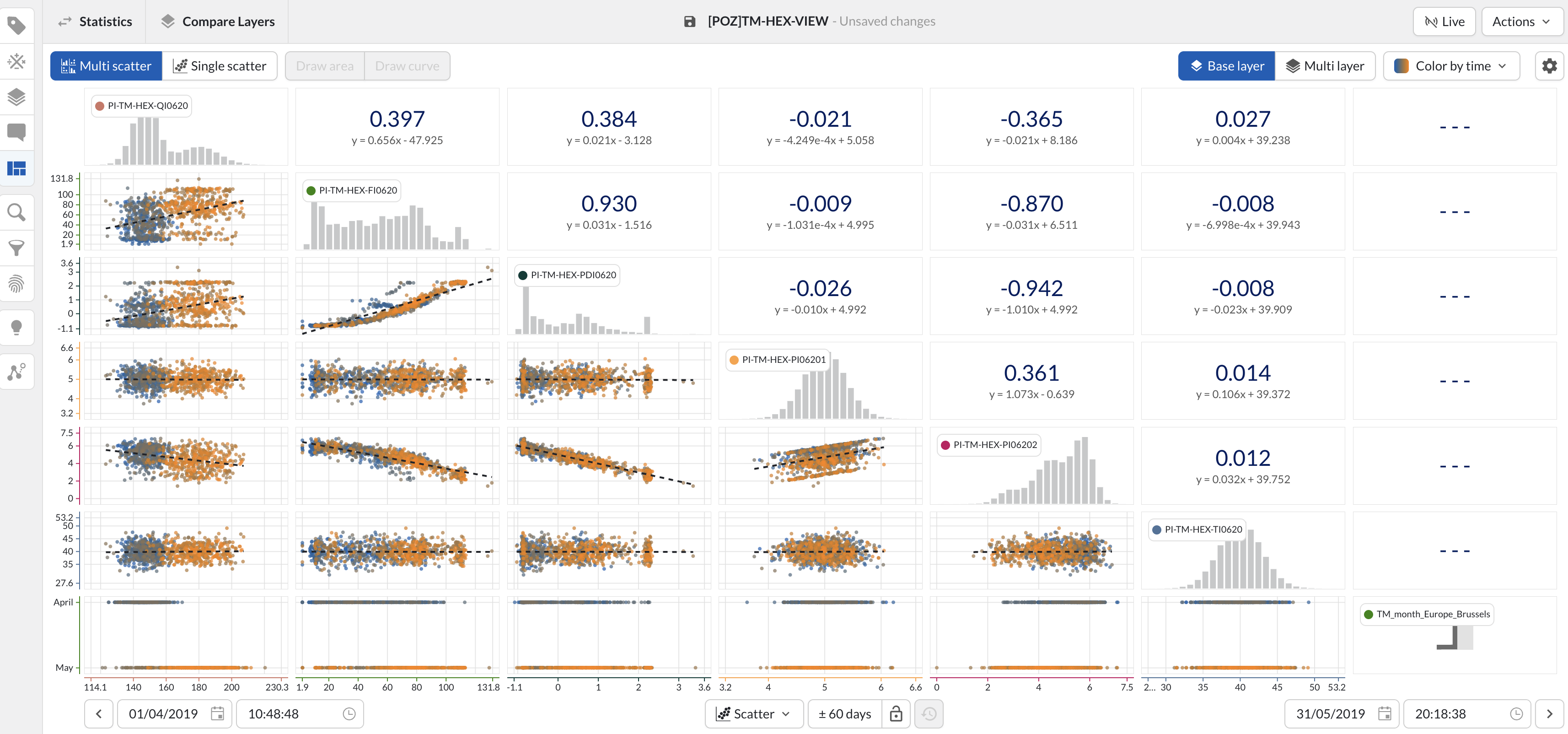
- Correlation analysis, scatter plots were used to identify relationships between operational variables
- Dynamic slope calculation, a derived tag measured charging and discharging rates of the storage tank
- Period filtering, stable demand windows were isolated to better understand system behavior
- Pattern identification, characteristic profiles were identified for normal, cold day, and weekend operation scenarios
Key Insight
The CHP often started too late, especially on weekends or holidays, causing unnecessary gas boiler activation even when CHP capacity could have covered demand if started earlier.
The Results
The Takeaway
By transforming operational data into actionable intelligence, the team uncovered hidden optimization potential, reduced unnecessary boiler usage, established a foundation for predictive dispatch strategies, and prepared the system for future forecasting and machine learning driven control, improving efficiency and operational flexibility across the CHP plant.
The Challenge
In a district heating system, a combined heat and power unit operates alongside a gas boiler to meet fluctuating thermal demand. A heat storage tank acts as a buffer between generation and consumption. Traditionally, the system was controlled using fixed rules, but increasing variability in outside temperature and electricity prices made this approach inefficient.
Operators needed to understand how CHP operation influenced storage charging and discharging behavior under different external conditions, and more importantly, determine when the CHP should start to avoid unnecessary boiler activation.
- Limited visibility into storage charging and discharging dynamics
- Static control logic unable to adapt to changing conditions
- Risk of late CHP starts triggering gas boiler use
- Difficulty identifying optimal start timing rules
The Approach
Engineers conducted a structured time series analysis to uncover operational patterns and define smarter dispatch logic.
- Historical data exploration, relevant tags such as tank level, CHP output, demand, and outside temperature were analyzed
- Correlation analysis, scatter plots were used to identify relationships between operational variables
- Dynamic slope calculation, a derived tag measured charging and discharging rates of the storage tank
- Period filtering, stable demand windows were isolated to better understand system behavior
- Pattern identification, characteristic profiles were identified for normal, cold day, and weekend operation scenarios
Key Insight
The CHP often started too late, especially on weekends or holidays, causing unnecessary gas boiler activation even when CHP capacity could have covered demand if started earlier.
The Results
The Takeaway
By transforming operational data into actionable intelligence, the team uncovered hidden optimization potential, reduced unnecessary boiler usage, established a foundation for predictive dispatch strategies, and prepared the system for future forecasting and machine learning driven control, improving efficiency and operational flexibility across the CHP plant.
Access now
Share with a co-worker
The Challenge
In a district heating system, a combined heat and power unit operates alongside a gas boiler to meet fluctuating thermal demand. A heat storage tank acts as a buffer between generation and consumption. Traditionally, the system was controlled using fixed rules, but increasing variability in outside temperature and electricity prices made this approach inefficient.
Operators needed to understand how CHP operation influenced storage charging and discharging behavior under different external conditions, and more importantly, determine when the CHP should start to avoid unnecessary boiler activation.
- Limited visibility into storage charging and discharging dynamics
- Static control logic unable to adapt to changing conditions
- Risk of late CHP starts triggering gas boiler use
- Difficulty identifying optimal start timing rules
The Approach
Engineers conducted a structured time series analysis to uncover operational patterns and define smarter dispatch logic.
- Historical data exploration, relevant tags such as tank level, CHP output, demand, and outside temperature were analyzed
- Correlation analysis, scatter plots were used to identify relationships between operational variables
- Dynamic slope calculation, a derived tag measured charging and discharging rates of the storage tank
- Period filtering, stable demand windows were isolated to better understand system behavior
- Pattern identification, characteristic profiles were identified for normal, cold day, and weekend operation scenarios
Key Insight
The CHP often started too late, especially on weekends or holidays, causing unnecessary gas boiler activation even when CHP capacity could have covered demand if started earlier.
The Results
The Takeaway
By transforming operational data into actionable intelligence, the team uncovered hidden optimization potential, reduced unnecessary boiler usage, established a foundation for predictive dispatch strategies, and prepared the system for future forecasting and machine learning driven control, improving efficiency and operational flexibility across the CHP plant.
Access now
Subscribe to our newsletter
Stay up to date with our latest news and updates.
Webinars on Demand
Press Play on Operational Improvement
.jpg)
.jpg)
.jpg)
Other Resources
Explore Our Newest Content to Maximize Your Operational Efficiency