Share with a co-worker
All Resources
Use case


The Challenge
Water leakages were intermittently observed in a steam heat exchanger system and could only be detected indirectly by monitoring the level of a collection tank. While this confirmed that leaks existed, it did not reveal where they originated. Engineers needed a reliable way to pinpoint the source and timing of leakage events in order to reduce wastewater losses and improve operational efficiency.
The main difficulty was that leaks did not occur continuously and could originate from multiple exchangers. Without advanced analytics, identifying which unit was responsible required time-consuming manual investigation and process shutdown risk.
The Approach
Engineers deployed an analytical workflow combining event detection, process calculations, and monitoring:
- Value-based searches were configured to detect periods when tank level dropped, indicating leakage events
- Mass balance calculations were applied across individual heat exchangers to isolate the most likely source
- Derived tags were created to quantify deviations between expected and actual flow conditions
- OEE-related metrics were incorporated to evaluate operational impact and efficiency losses
- Automated monitoring was activated to detect future leakage signatures in real time
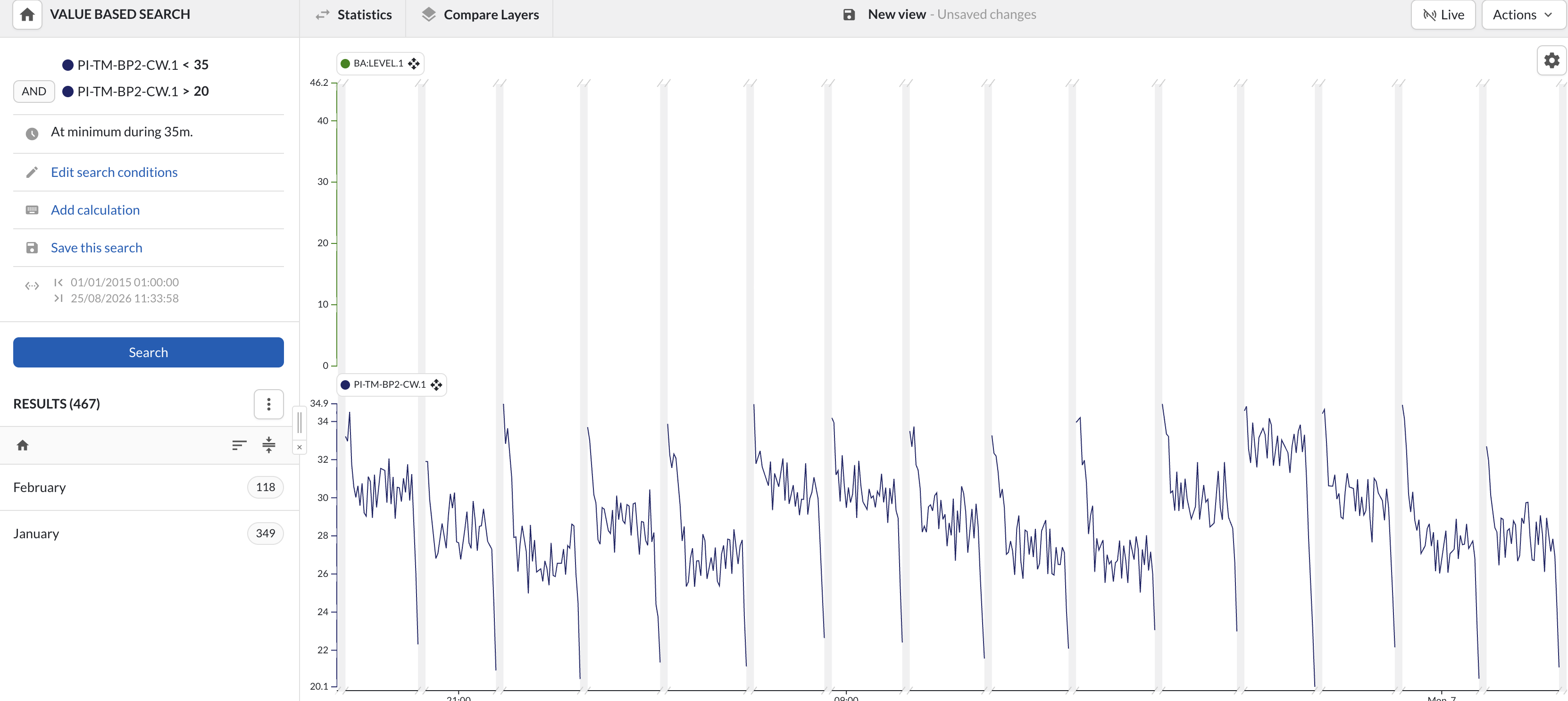
This structured method transformed a vague symptom (tank level drop) into a traceable diagnostic signal tied to specific assets.
The Results
The Takeaway
The implementation established a proactive leakage detection system that improves process efficiency while reducing environmental and operational costs. By combining mass balance analytics with automated monitoring, engineers gained continuous visibility into exchanger performance and could intervene earlier—ultimately increasing OEE and overall plant reliability.
The Challenge
Water leakages were intermittently observed in a steam heat exchanger system and could only be detected indirectly by monitoring the level of a collection tank. While this confirmed that leaks existed, it did not reveal where they originated. Engineers needed a reliable way to pinpoint the source and timing of leakage events in order to reduce wastewater losses and improve operational efficiency.
The main difficulty was that leaks did not occur continuously and could originate from multiple exchangers. Without advanced analytics, identifying which unit was responsible required time-consuming manual investigation and process shutdown risk.
The Approach
Engineers deployed an analytical workflow combining event detection, process calculations, and monitoring:
- Value-based searches were configured to detect periods when tank level dropped, indicating leakage events
- Mass balance calculations were applied across individual heat exchangers to isolate the most likely source
- Derived tags were created to quantify deviations between expected and actual flow conditions
- OEE-related metrics were incorporated to evaluate operational impact and efficiency losses
- Automated monitoring was activated to detect future leakage signatures in real time
This structured method transformed a vague symptom (tank level drop) into a traceable diagnostic signal tied to specific assets.
The Results
The Takeaway
The implementation established a proactive leakage detection system that improves process efficiency while reducing environmental and operational costs. By combining mass balance analytics with automated monitoring, engineers gained continuous visibility into exchanger performance and could intervene earlier—ultimately increasing OEE and overall plant reliability.
Access now
Share with a co-worker
The Challenge
Water leakages were intermittently observed in a steam heat exchanger system and could only be detected indirectly by monitoring the level of a collection tank. While this confirmed that leaks existed, it did not reveal where they originated. Engineers needed a reliable way to pinpoint the source and timing of leakage events in order to reduce wastewater losses and improve operational efficiency.
The main difficulty was that leaks did not occur continuously and could originate from multiple exchangers. Without advanced analytics, identifying which unit was responsible required time-consuming manual investigation and process shutdown risk.
The Approach
Engineers deployed an analytical workflow combining event detection, process calculations, and monitoring:
- Value-based searches were configured to detect periods when tank level dropped, indicating leakage events
- Mass balance calculations were applied across individual heat exchangers to isolate the most likely source
- Derived tags were created to quantify deviations between expected and actual flow conditions
- OEE-related metrics were incorporated to evaluate operational impact and efficiency losses
- Automated monitoring was activated to detect future leakage signatures in real time
This structured method transformed a vague symptom (tank level drop) into a traceable diagnostic signal tied to specific assets.
The Results
The Takeaway
The implementation established a proactive leakage detection system that improves process efficiency while reducing environmental and operational costs. By combining mass balance analytics with automated monitoring, engineers gained continuous visibility into exchanger performance and could intervene earlier—ultimately increasing OEE and overall plant reliability.
Access now
Subscribe to our newsletter
Stay up to date with our latest news and updates.
Webinars on Demand
Press Play on Operational Improvement
.jpg)
.jpg)
.jpg)
Other Resources
Explore Our Newest Content to Maximize Your Operational Efficiency