Share with a co-worker
All Resources
Use case

The Challenge
The fired heater run length is a key driver of DCU on-stream factor and directly impacts unit profitability and refinery performance. Monitoring revealed that the furnace was not reaching its expected run length, limiting operational efficiency and constraining overall performance.
Current runs averaged around three months, and increasing that duration was a clear operational priority. The situation was complicated by changing feed conditions compared to original design assumptions, making it necessary to understand which variables were shortening runtime. Shutdowns could occur due to trips or when skin temperature approached the 650 °C limit, so identifying the factors influencing skin temperature became critical.
- Run length limited to roughly three months
- Reduced profitability due to shorter operating cycles
- Changing feed conditions affecting performance
- Need to identify drivers of high skin temperature
The Approach
The team built a structured analysis workflow to isolate the variables affecting furnace skin temperature and, consequently, run length.
- Run period detection: Value Based Search was used to identify all operating periods based on feed flowrate
- Cross-run comparison: Multiple runs were overlaid to evaluate how different process variables influenced skin temperature behavior
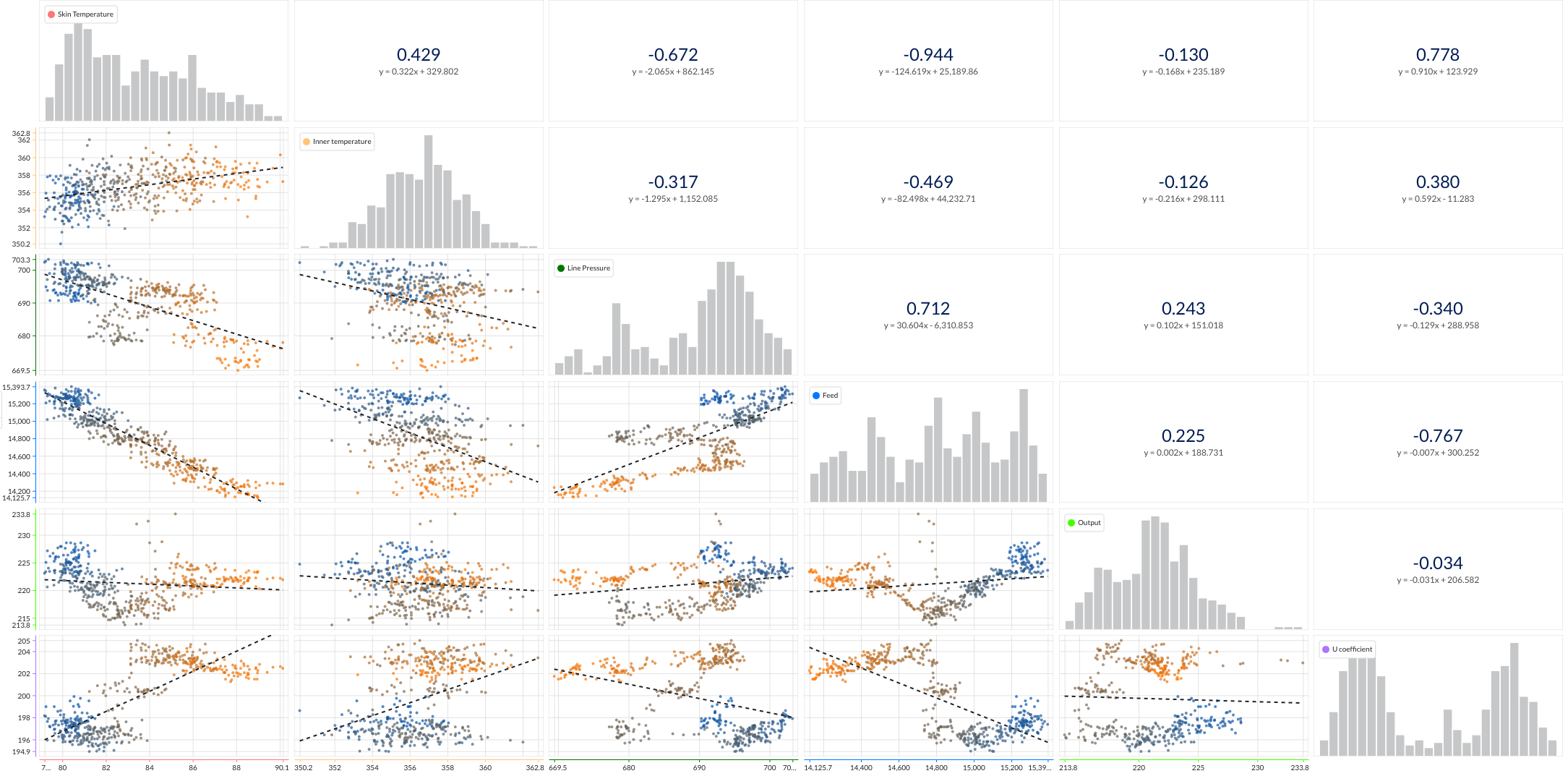
- Correlation validation: Scatter-plot analysis over extended time ranges confirmed statistical relationships between process variables and temperature
- Root cause exploration: Parameters suspected to affect skin temperature were analyzed individually to isolate their influence
- Controlled testing strategy: The team defined a plan to modify one parameter at a time to validate cause-effect relationships cleanly
Key Insight
Run length was not constrained by a single limitation, it was strongly influenced by operating conditions, especially feed flowrate and combustion-related variables.
Results
The Takeaway
By identifying the operational variables that directly influence furnace skin temperature, the team established a clear path to extend run length, improve DCU availability, and increase refinery profitability through data-guided operating adjustments rather than trial and error.
The Challenge
The fired heater run length is a key driver of DCU on-stream factor and directly impacts unit profitability and refinery performance. Monitoring revealed that the furnace was not reaching its expected run length, limiting operational efficiency and constraining overall performance.
Current runs averaged around three months, and increasing that duration was a clear operational priority. The situation was complicated by changing feed conditions compared to original design assumptions, making it necessary to understand which variables were shortening runtime. Shutdowns could occur due to trips or when skin temperature approached the 650 °C limit, so identifying the factors influencing skin temperature became critical.
- Run length limited to roughly three months
- Reduced profitability due to shorter operating cycles
- Changing feed conditions affecting performance
- Need to identify drivers of high skin temperature
The Approach
The team built a structured analysis workflow to isolate the variables affecting furnace skin temperature and, consequently, run length.
- Run period detection: Value Based Search was used to identify all operating periods based on feed flowrate
- Cross-run comparison: Multiple runs were overlaid to evaluate how different process variables influenced skin temperature behavior
- Correlation validation: Scatter-plot analysis over extended time ranges confirmed statistical relationships between process variables and temperature
- Root cause exploration: Parameters suspected to affect skin temperature were analyzed individually to isolate their influence
- Controlled testing strategy: The team defined a plan to modify one parameter at a time to validate cause-effect relationships cleanly
Key Insight
Run length was not constrained by a single limitation, it was strongly influenced by operating conditions, especially feed flowrate and combustion-related variables.
Results
The Takeaway
By identifying the operational variables that directly influence furnace skin temperature, the team established a clear path to extend run length, improve DCU availability, and increase refinery profitability through data-guided operating adjustments rather than trial and error.
Access now
Share with a co-worker
The Challenge
The fired heater run length is a key driver of DCU on-stream factor and directly impacts unit profitability and refinery performance. Monitoring revealed that the furnace was not reaching its expected run length, limiting operational efficiency and constraining overall performance.
Current runs averaged around three months, and increasing that duration was a clear operational priority. The situation was complicated by changing feed conditions compared to original design assumptions, making it necessary to understand which variables were shortening runtime. Shutdowns could occur due to trips or when skin temperature approached the 650 °C limit, so identifying the factors influencing skin temperature became critical.
- Run length limited to roughly three months
- Reduced profitability due to shorter operating cycles
- Changing feed conditions affecting performance
- Need to identify drivers of high skin temperature
The Approach
The team built a structured analysis workflow to isolate the variables affecting furnace skin temperature and, consequently, run length.
- Run period detection: Value Based Search was used to identify all operating periods based on feed flowrate
- Cross-run comparison: Multiple runs were overlaid to evaluate how different process variables influenced skin temperature behavior
- Correlation validation: Scatter-plot analysis over extended time ranges confirmed statistical relationships between process variables and temperature
- Root cause exploration: Parameters suspected to affect skin temperature were analyzed individually to isolate their influence
- Controlled testing strategy: The team defined a plan to modify one parameter at a time to validate cause-effect relationships cleanly
Key Insight
Run length was not constrained by a single limitation, it was strongly influenced by operating conditions, especially feed flowrate and combustion-related variables.
Results
The Takeaway
By identifying the operational variables that directly influence furnace skin temperature, the team established a clear path to extend run length, improve DCU availability, and increase refinery profitability through data-guided operating adjustments rather than trial and error.
Access now
Subscribe to our newsletter
Stay up to date with our latest news and updates.
Webinars on Demand
Press Play on Operational Improvement
.jpeg)
.jpeg)
.jpeg)
Other Resources
Explore Our Newest Content to Maximize Your Operational Efficiency