Share with a co-worker
All Resources
Use case


The Challenge
Stable process control depends on properly functioning control valves. However, intermittent oscillations and slow valve responses were observed, creating variability in controlled systems. These behaviors can degrade process stability, reduce efficiency, and increase mechanical wear.
The main difficulty was identifying when and where these abnormal valve behaviors occurred, especially since they appeared sporadically and were not always obvious in standard trend views.
The Approach
Engineers implemented a pattern-based analysis workflow using advanced search and comparison techniques:
- Similarity search was used to detect historical occurrences of the same oscillation patterns
- Weighted searches allowed prioritization of critical signals
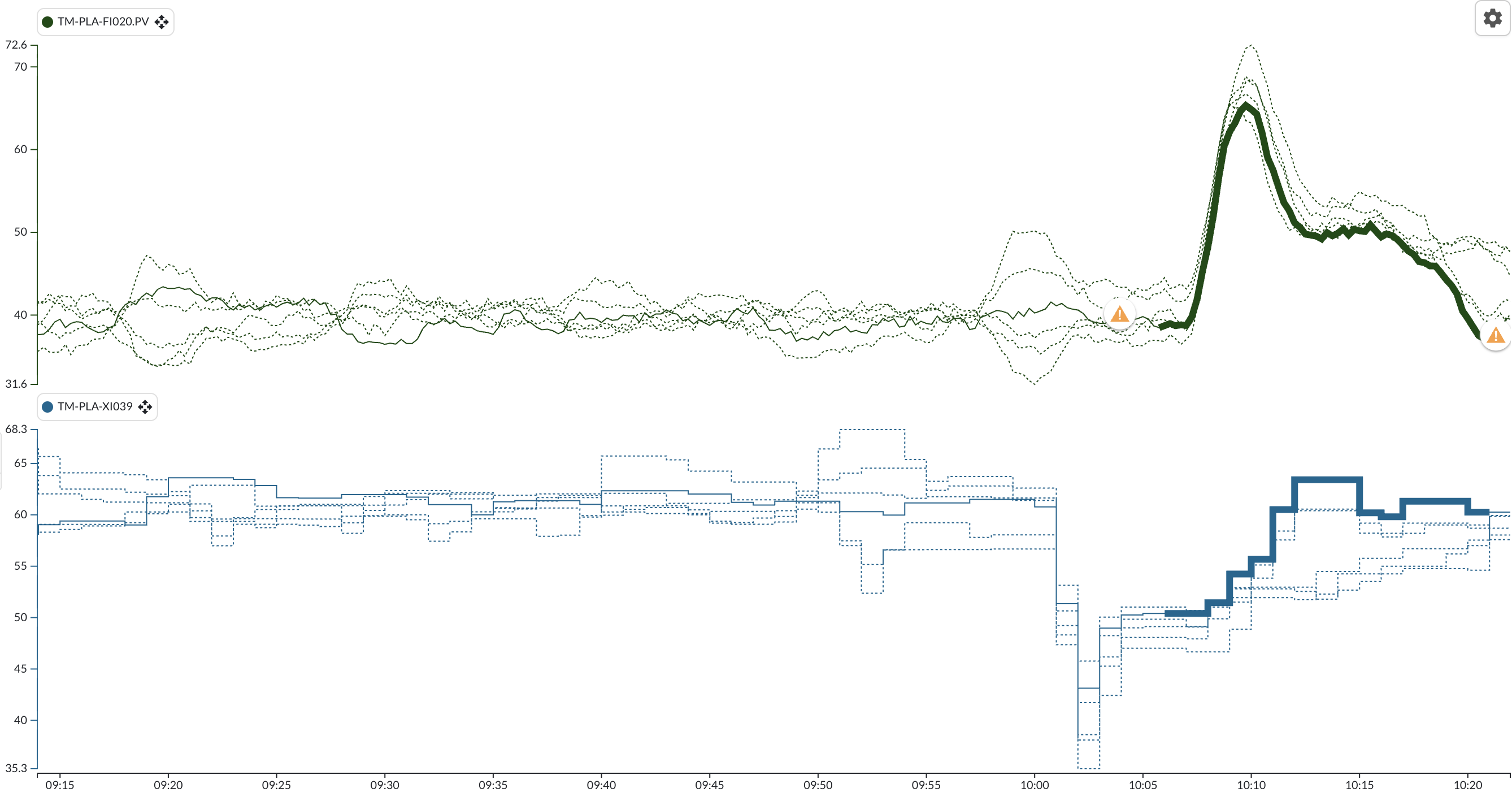
- Layered overlays enabled visual comparison of multiple similar events
- Smoothed values were applied to remove noise and highlight underlying behavior
- Aggregated signals (e.g., hourly averages and central values) were used to improve pattern clarity
This approach allowed systematic identification of recurring dynamic behaviors rather than relying on manual inspection.
The Results
The Takeaway
The analysis demonstrated how pattern recognition can be used to proactively detect control loop issues before they escalate into operational problems. It also established a repeatable methodology that can be expanded with saved searches, automated monitors, dashboards, and context events to support continuous monitoring and troubleshooting.
The Challenge
Stable process control depends on properly functioning control valves. However, intermittent oscillations and slow valve responses were observed, creating variability in controlled systems. These behaviors can degrade process stability, reduce efficiency, and increase mechanical wear.
The main difficulty was identifying when and where these abnormal valve behaviors occurred, especially since they appeared sporadically and were not always obvious in standard trend views.
The Approach
Engineers implemented a pattern-based analysis workflow using advanced search and comparison techniques:
- Similarity search was used to detect historical occurrences of the same oscillation patterns
- Weighted searches allowed prioritization of critical signals
- Layered overlays enabled visual comparison of multiple similar events
- Smoothed values were applied to remove noise and highlight underlying behavior
- Aggregated signals (e.g., hourly averages and central values) were used to improve pattern clarity
This approach allowed systematic identification of recurring dynamic behaviors rather than relying on manual inspection.
The Results
The Takeaway
The analysis demonstrated how pattern recognition can be used to proactively detect control loop issues before they escalate into operational problems. It also established a repeatable methodology that can be expanded with saved searches, automated monitors, dashboards, and context events to support continuous monitoring and troubleshooting.
Access now
Share with a co-worker
The Challenge
Stable process control depends on properly functioning control valves. However, intermittent oscillations and slow valve responses were observed, creating variability in controlled systems. These behaviors can degrade process stability, reduce efficiency, and increase mechanical wear.
The main difficulty was identifying when and where these abnormal valve behaviors occurred, especially since they appeared sporadically and were not always obvious in standard trend views.
The Approach
Engineers implemented a pattern-based analysis workflow using advanced search and comparison techniques:
- Similarity search was used to detect historical occurrences of the same oscillation patterns
- Weighted searches allowed prioritization of critical signals
- Layered overlays enabled visual comparison of multiple similar events
- Smoothed values were applied to remove noise and highlight underlying behavior
- Aggregated signals (e.g., hourly averages and central values) were used to improve pattern clarity
This approach allowed systematic identification of recurring dynamic behaviors rather than relying on manual inspection.
The Results
The Takeaway
The analysis demonstrated how pattern recognition can be used to proactively detect control loop issues before they escalate into operational problems. It also established a repeatable methodology that can be expanded with saved searches, automated monitors, dashboards, and context events to support continuous monitoring and troubleshooting.
Access now
Subscribe to our newsletter
Stay up to date with our latest news and updates.
Webinars on Demand
Press Play on Operational Improvement
.jpg)
.jpg)
.jpg)
Other Resources
Explore Our Newest Content to Maximize Your Operational Efficiency