Industrial AI, Done Right: What Data Centers Can Learn from the Process and Power Industries
Data centers are building the infrastructure for AI. Who's optimizing the infrastructure itself?
Data centers have become the physical backbone of AI infrastructure, yet the operational maturity behind that backbone has not kept pace with what it now supports. Many facilities already run tools that are strong on control and monitoring, or narrow AI tools focused on one system like thermal. Most facilities can already see that something changed. Few can trace why it changed across the systems that caused it. A temperature spike in the cooling cycle traces back to a power event three systems away, and only someone who has seen it before makes the connection in time. A cooling tower slowly losing efficiency to fouling shows up as a rising energy bill months before anyone traces it to the actual cause.
That diagnostic work depends on a handful of people who have seen enough failures to recognize the next one, and they rarely have time to trace fragmented data before it's time to act. According to Uptime Institute, that expertise is concentrated, not distributed, and the industry's own research says the gap is widening rather than closing.
The industry building the infrastructure for artificial intelligence has rarely turned that intelligence on itself. The physics is familiar. The analytics maturity is what's missing.
A data center is like a process plant
A data center has no hazardous chemicals and no complex reactions, but the operational challenges are similar to a process plant: energy efficiency, asset reliability, uptime. And the assets are similar too. Chillers, cooling towers, air handling units, compressors, pumps, heat exchangers: the same equipment, running the same continuous operations.
The stakes are concrete. Combined power and cooling failures already account for roughly 60 to 73% of significant data center outages, according to Uptime Institute's Annual Outage Analysis. And on the cost side, the U.S. Department of Energy estimates cooling can account for up to 40% of data center energy usage overall, depending on facility type and efficiency. The systems that fail the most are also the systems that cost the most to run.
Process industries have spent decades building the analytics maturity to answer these challenges. TrendMiner is used across power generation and close to half the chemical industry to do it: monitoring and reporting on equipment performance, catching drift before it becomes downtime, surfacing root cause across domains that used to be analyzed in isolation. The physics data centers run on has already been studied and optimized elsewhere.
Data centers are also increasingly operated in environments where change is constant rather than exceptional: live infrastructure changes that make anomaly detection or scenario validation necessary, fluctuating demand that requires forecasting and planning, and sustainability reporting under increasingly strict regulation. More than half of operators now track water use specifically, according to Uptime Institute's 2026 survey, adding water to the energy and emissions reporting load.
The skill gap, and the trust gap it creates
Operational data is already collected in many data centers, much like in the process industry. But it is often fragmented, sitting across EPMS, DCIM, and other systems that were never built to talk to each other. And there are only a few people who can process large amounts of that data, and even fewer with real, deep expertise.
The data center industry faces a massive staffing shortage. Big players like AWS, Microsoft, and Google are already building their own training pipelines to cope, according to the World Economic Forum, and Uptime Institute's 2026 survey found more than half of operators struggle to find qualified candidates. The result is teams under constant uptime pressure, expected to know what to do and how to act quickly.
That shortage often pushes facilities toward AI to cover the gap. That AI is often a black box. It produces a verdict without showing the reasoning behind it. It covers the gap on paper, but the diagnostic burden still lands on the same few specialists it was supposed to relieve.
Left unaddressed, this has two consequences. The first is trust. A tool that hands back an answer with no reasoning attached gives staff nothing to check it against, and no way to trust it during an abnormal event when it matters most. This is already showing up in the data. Uptime Institute's 2026 survey found that operator trust in AI's operational benefits declined slightly this year, with confidence highest for the lower-risk applications, like sensor data analytics and predictive maintenance, that show their reasoning.
The second is skill decay. According to Uptime Institute, overreliance on AI and automation can weaken diagnostic judgment, situational awareness, and confidence during abnormal events, since staff supervising a black box have nothing to learn from except the answer itself. MIT Sloan economist Simon Johnson calls the alternative pro-worker AI. His own example is a data center technician, whose job already involves interpreting operational data and spotting early risk. AI that surfaces the reasoning behind a finding lets that technician build judgment. AI that just hands back an answer does not.
What data centers need is what the rare specialists need too: AI and analytics fast and easy enough to run across large, complex datasets, without a data science queue, transparent enough to build trust rather than erode it.
The TrendMiner Analytics Agent: Industrial AI, done right
TrendMiner already analyzes process data across close to half the chemical industry. The same analytics approach can now be applied to data centers. Data center facility teams look a lot like the process industry customers TrendMiner already serves: constant uptime pressure, and not enough time to dig through large amounts of data before deciding what to act on.
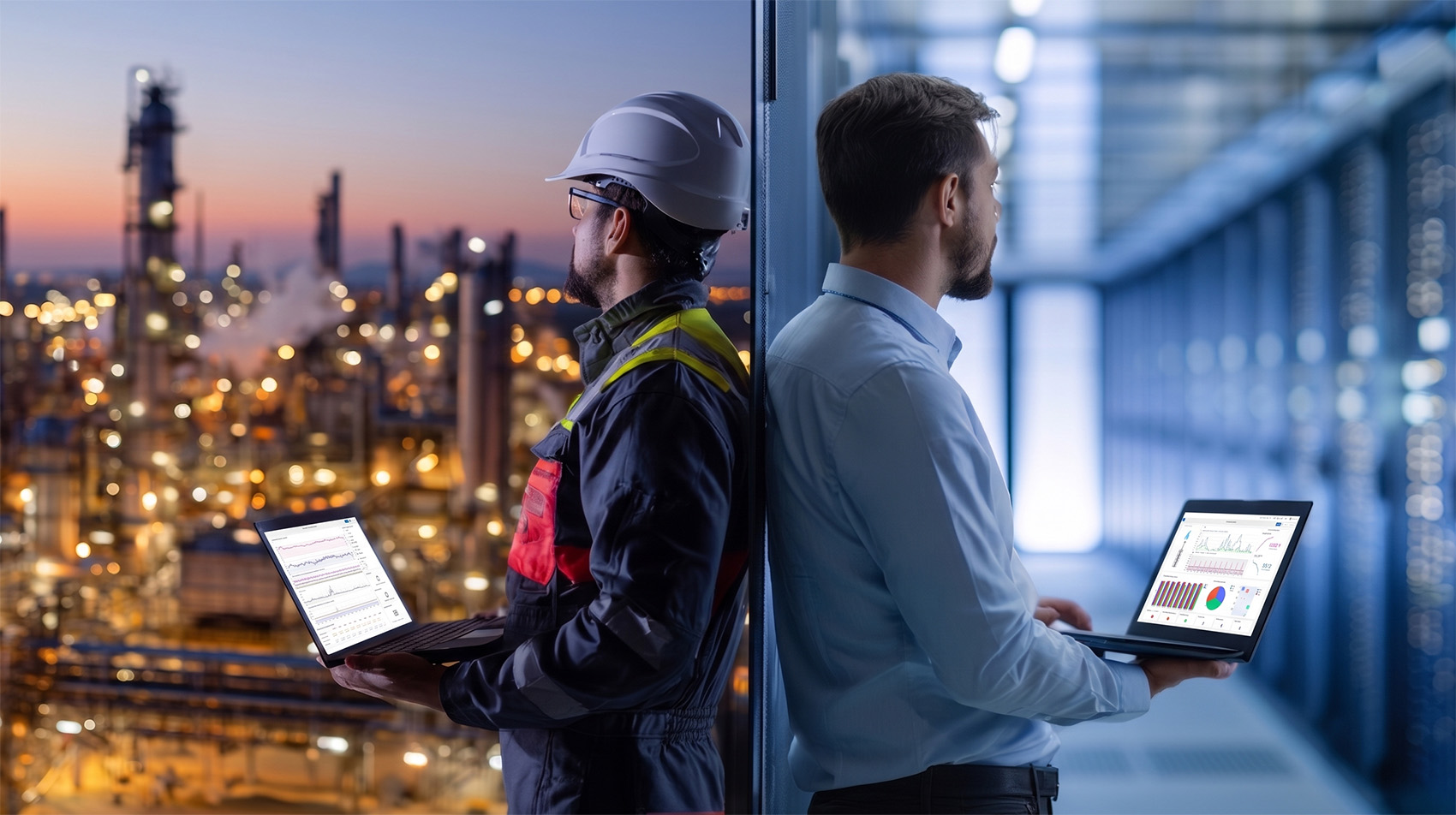
That is exactly the gap the TrendMiner Analytics Agent closes. A cross-domain anomaly no longer waits for the one specialist who has seen the pattern before. The agent lays out the correlation across systems directly, so any engineer can investigate and reach root cause while it still matters.
The agent works alongside what is already in place rather than replacing it. TrendMiner connects to the historians, DCIM, EPMS, and BMS platforms data centers already run, the same vendor-agnostic approach it uses across historians in the process industry. No rip and replace, no forced migration of operational data into someone else's cloud.
The Analytics Agent delivers the explainability and structure engineers require, with the predictability operations leaders can trust.
For the engineers using it:
- Consistent. Analyses and saved items give repeatable structure to your prompts: the same answer when you present your findings the next day.
- Explainable. No black box. Tools, assumptions and analyses are transparent, and specific parts are editable without rerunning the prompt.
- Actionable. Practical insights with a path forward, made repeatable through monitors, reports and visualizations.
For the leaders buying it:
- Predictable. AI tooling pricing is volatile. TrendMiner provides AI features on a predictable per-seat basis.
- Trustworthy. The agent uses your connected data and TrendMiner's industry-specific tools, keeping a human in the loop for verification.
- Flexible. Bring your own model fits existing service agreements. Switch providers or move in-house, and we adjust with you.
This is not a narrow tool built for one problem. The same agent supports energy efficiency and cooling equipment optimization, heat exchanger fouling monitoring, and sustainability and mandatory KPI reporting, through the same time-series analysis, monitoring, and reporting used across all of it.
The model is not the advantage. Process data and domain experts are. The TrendMiner Analytics Agent gives data centers the way to put both to work, fast.
Not sure where your current tooling stops and cross-domain analytics begins? Start with the guide below: it includes a side-by-side comparison of DCIM, newer analytics tools, and cross-domain analytics, and where each sits against the 17 vendors in Verdantix's own data center management benchmark. And if you want to see the Analytics Agent on your own cooling data, talk to us.
See it in action
TrendMiner’s analytics approach is proven across the process industries it already serves:
- Production increase through correlation analysis in a cooler of a combined-cycle plant: a 1% production increase.
- Optimizing operating conditions for a heat exchanger.
- Preventing pump resonance failure: saving up to $360k per equipment per day.